

Introduction
Thailand’s luxury travel reputation is most often anchored to its coastline. The karsts of Krabi, the bays of Koh Samui, the Andaman waters of Phuket. These are exceptional settings, and the resorts that occupy them have set a high global standard. But for the traveller ready for something categorically different, Chiang Rai and the Golden Triangle offer a compelling alternative. Where the borders of Thailand, Laos, and Myanmar converge, the region presents lush highland landscapes, mist-covered hills, winding rivers, and a cultural history that spans ancient temples, hill tribe villages, and centuries of cross-border exchange, entrancing with a depth of place that no beach destination in the country can replicate.
What sets it apart from a beach resort comes down to three things: landscape, culture, and experience. So, finding out what the best luxury resorts in Chiang Rai, Thailand and its surrounding environments to explore is useful.
A Landscape sculptured by Nature
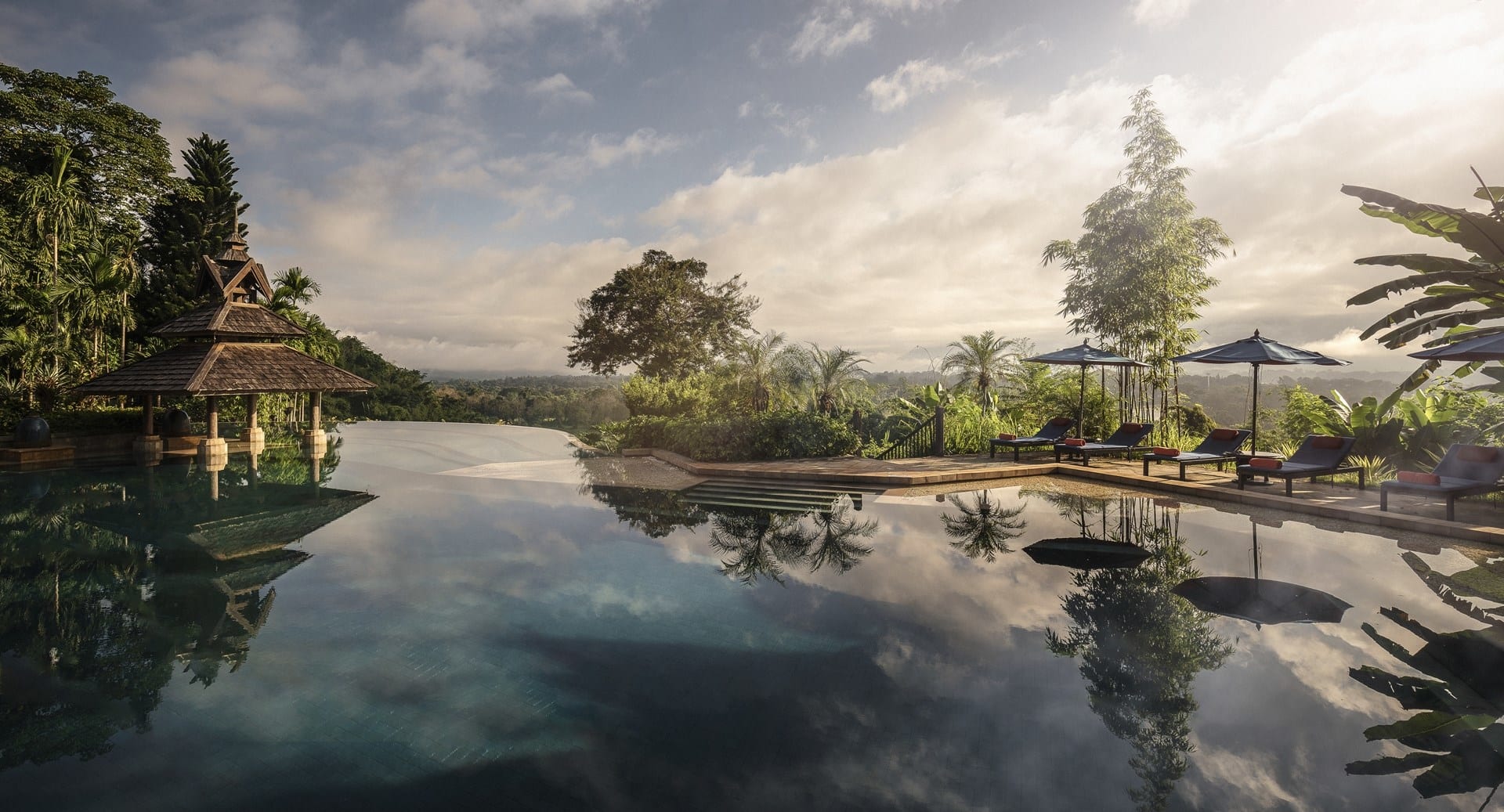
The most fundamental difference between a luxury resort in Chiang Rai and one on Thailand’s coast is the landscape itself — and the way that landscape defines every dimension of the stay. Beach resorts, however refined, are built around a single natural element. The setting in Chiang Rai’s Golden Triangle is layered: highland jungle, river valley, mountain ridgeline, and the physical convergence of three nations, all visible from a single vantage point.
At the exact confluence of the Mekong and Ruak rivers, travellers can stand on Thai soil and look out simultaneously across Thailand, Laos, and Myanmar — a geographic reality with no equivalent anywhere on the country’s coastline. Chiang Rai itself sits at an elevation of 350 metres, in the basin of the Kok River near the Khun Tan Range, giving the region a cooler, mist-laden climate that shapes the character of a stay in ways that temperature and humidity at the beach simply do not.
A Place of Culture, not Curation
The cultural offer of Chiang Rai is unlike anything a beach resort can provide — not because it is more refined, but because it is more layered. Chiang Rai Province spans 11,678 square kilometres and supports a population of approximately 1.28 million people, with hill tribes accounting for around 12.5% of that population — primarily the Akha, Hmong, Lisu, Karen, Lahu, and Yao groups, each with distinct languages, spiritual traditions, and craft practices that have survived across generations. Hundreds of hill tribe villages are scattered throughout the province, a legacy of historical migration across the borders of China, Laos, and Myanmar — communities that settled in search of arable land or refuge, and whose presence today makes Chiang Rai one of the most ethnically diverse regions in Southeast Asia. For the luxury traveller, access to these communities — arranged responsibly and with genuine cultural intention — represents an experience that no beach holiday, however well-conceived, can replicate.
The region’s history adds another dimension. By the 1960s, the Golden Triangle produced over half the world’s opium supply — a period now documented with considerable depth at the Hall of Opium Museum. A visit to the Hall of Opium is an opportunity to explore the Golden Triangle’s complex past alongside the alternative livelihood projects of the late Princess Mother, now used as a global case study in sustainable development. This kind of historically weighted, place-specific narrative simply does not exist at a beach resort — it belongs entirely to this corner of northern Thailand, and it gives the stay an intellectual depth that distinguishes it from almost any other luxury destination in the country.
A Broad Set of Activities
The question of what to do during a stay is where the Chiang Rai luxury experience diverges most sharply from a coastal one. Beach resorts, by definition, orient their activity programming around the water — snorkelling, diving, sailing, sunset cruises. These are pleasures with real appeal, but they operate within a narrow register. A stay at a luxury resort in the Golden Triangle draws from an entirely different range of experiences, each shaped by the specific character of the landscape, wildlife, and cultures surrounding it.
At the centre of that offer is the elephant. Anantara Golden Triangle‘s elephant camp allows guests to journey into the jungle with elephants and their mahouts on their daily walk — watching as these animals splash in the river, forage from nearby branches, and interact with one another in their natural habitat The Golden Triangle Asian Elephant Foundation serves as a home for elephants rescued primarily from illegal logging camps, street begging, and commercial shows — giving the experience a conservation dimension that is as meaningful as it is memorable. For families, couples, and corporate groups seeking an activity that is both extraordinary and ethically grounded, this alone sets the Chiang Rai stay apart from any coastal alternative.
The broader activity landscape is equally varied. Guests can explore neighbouring Chiang Saen’s ancient ruins, take longtail boat trips to Laos, cycle through highland trails, trek through jungle paths, plant trees or spend a full day learning the traditional art of the mahout.